The Flemish electricity grid is full. But that doesn't mean your project has to wait.

The energy transition is in full swing. Electric vehicles, heat pumps, electric boilers, data centres, charging parks and industrial batteries: all of them require a heavier grid connection than they did ten years ago. Fluvius looks not only at what is connected to the grid today, but at what is expected by 2035. And that projection reveals a problem in a growing number of areas: the transformer station in your region no longer has enough capacity to serve everyone at peak moments.
An important nuance: there is no shortage of electricity. The problem lies in the transport capacity of the grid — the ability to move that electricity to the right place at the right time. The official Fluvius data table (as of 30 April 2026) illustrates the scale of the problem: 883 requests for a flexible connection are still awaiting an offer, 574 standard connections are in the same situation, and 423 battery files requiring additional contractual capacity are completely stalled pending a policy change. For households, nothing changes for now — this concerns high and very high power connections only.
What is Fall-Back Flex?
Fall-Back Flex is the temporary solution Fluvius uses to still connect businesses in zones where grid congestion is expected. The logic is straightforward: instead of saying "no", Fluvius says "yes, but with one condition."
You get the full connection you requested. But Fluvius retains the right to ask you to temporarily reduce your power consumption during moments of imminent overload. That signal is sent via a telecontrol cabinet — more on that below. In practice, this happens rarely: only at genuine peak moments, when the grid cannot cope otherwise.
In April 2026, the Flemish Utilities Regulator (VNR) relaxed the conditions for Fall-Back Flex. Previously, Fluvius had to be able to point to a concrete, immediate grid investment for every flex contract. This turned out to be a bottleneck in practice. From now on, it is sufficient for that investment to be included in the next investment plans — which means Fluvius can now unblock hundreds of waiting files.
What's the catch?
Fall-Back Flex is not a no-strings-attached contract. You give Fluvius the contractual right to remotely control your installation. For businesses with a flexible energy demand — such as a battery that already responds to consumption peaks — this is rarely an issue. But for a manufacturing company whose machines are running at full capacity at that exact moment, a reduction signal can have operational consequences. This needs to be carefully assessed in advance.
There is also a technical obligation: to receive and act on that signal at all, your installation must be equipped with telecontrol.
What is telecontrol — and who pays for it?
Telecontrol is the system Fluvius uses to remotely monitor and control large energy installations. It is mandatory for distributed energy resources (DER) — solar parks, wind installations, CHP and batteries — from 1 MVA onwards. A proposal is in progress to lower that threshold to 100 kW for batteries, specifically to allow more BESS projects to connect in a congestion-neutral way.
The system consists of two components.
- The telecontrol cabinet (TCK) is provided by Fluvius and installed at your site. It contains Fluvius's own communication module and is directly connected to their central grid management system. Fluvius provides the cabinet, but installation costs and the fibre connection are borne by the client.
- The client RTU — also referred to as a DER controller or EMS interface — is your responsibility. This is the controller you install as the bridge between the Fluvius cabinet and your own installations: the battery, the inverters, the charging points. Without this controller, the Fluvius TCK cannot function. It is also the technically complex part of the puzzle, as this controller must speak the right protocols, process real-time setpoints and respond correctly to control signals.
Exception: if Fluvius subsequently decides to impose telecontrol on an existing installation, Fluvius bears all costs — both the cabinet and any necessary modifications to the installation.
What about battery projects specifically?
BESS projects (Battery Energy Storage Systems) fall into a separate category at Fluvius. A battery is in theory an ideal partner for the grid: it charges when there is a surplus and discharges when the grid is under pressure. But at the same time, an industrial battery requires a heavy grid connection to charge — which once again puts pressure on transport capacity.
Fluvius therefore handles battery files separately from regular business connections. The official figures show just how stuck this segment is: 423 battery files requiring additional contractual capacity are waiting without an offer, as a new flexible connection contract is needed first. For the 106 battery files with technical flexibility, that contract is under development — Fluvius and the VNR are currently negotiating the exact terms. A final decision is expected during 2026.
And the FAO — what exactly is that?
Fall-Back Flex is a temporary bridge. Its structural successor is called the Flexible Connection Agreement (FAO). The decree enabling the FAO was definitively approved by the Flemish government in October 2025. Anyone who signs a Fall-Back Flex contract today will automatically be converted to a FAO in due course.
The concrete implementing rules are still being worked out. A concern raised by the sector itself: banks and investors want to know in advance how often and under what circumstances Fluvius can limit an installation, so they can calculate a worst-case scenario for project financing. As long as those guarantees are not set out in writing, financing larger BESS projects remains more complex.
The FAO only applies in congestion zones, and only for new connections or capacity increases above 1 MVA. It is also always linked to a planned grid investment: once that investment is completed, the flexible connection is converted into a permanent one.
Is your site in a congestion zone?
Fluvius publishes a congestion map that is updated monthly. The map shows per supply area which connection options are available for high and very high power demands — from green, where classic permanent connections are still possible, to orange, where only flexible connections remain an option. Fluvius also publishes up-to-date figures on all open files. The April 2026 table makes the scale of the problem concrete: 883 requests for a flexible connection are still awaiting an offer, and 423 battery files with additional contractual capacity are entirely stalled pending a policy change. These figures are updated monthly.
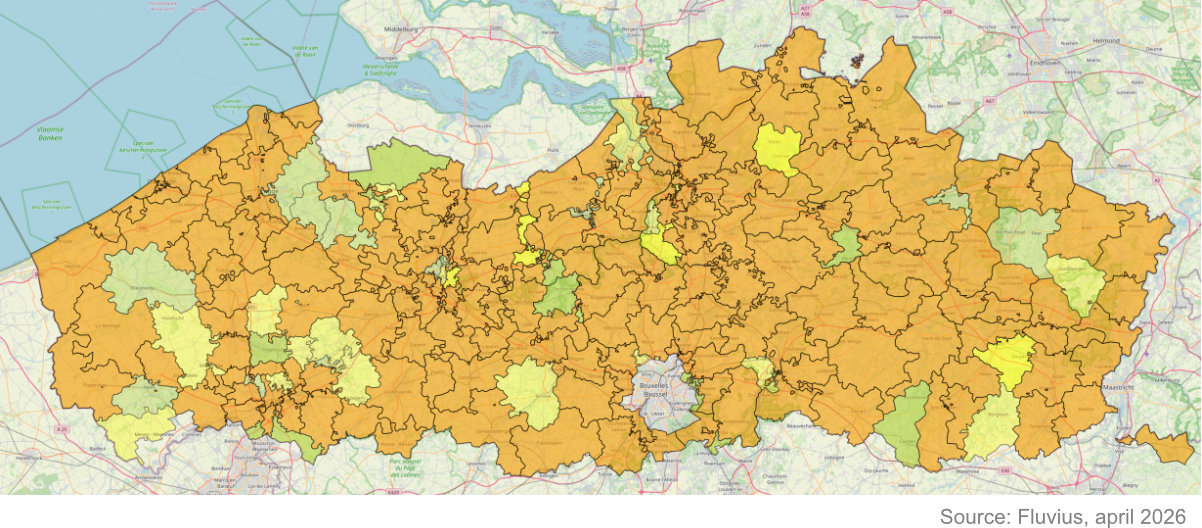
Map and figures can be consulted directly on the Fluvius Grid Congestion — Figures and Maps page.
What you can do now: submit your connection request with a well-documented file — the more concrete and complete your file, the faster Fluvius can work out a tailored solution. Make sure your installation is technically ready for telecontrol, with an EMS controller that supports the right protocols and communicates correctly with the Fluvius telecontrol cabinet. And understand what a flex contract means operationally for your business processes before you sign.
Regulations are evolving fast. Those who prepare now will be ahead of the curve.
Powerland guides you from application to connection
At Powerland, we know this landscape inside out. We support businesses not only with the installation of charging infrastructure, battery storage and solar panels — we also make sure the technical integration with the Fluvius grid is correct. From EMS configuration and the telecontrol interface to coordination with your connection file: we take care of it all.
One partner for everything — including what happens behind the meter and beyond the connection point.
Does your project require a heavy grid connection and do you want to know what that means technically for your installation? Our experts guide you from connection file to operational installation.
Back to overview