Skip to content

We value your privacy

We use cookies to optimize the functionality of the website and to provide you with the best possible experience. Click on “Accept cookies” to accept all cookies or set your own preferences. Read more about our cookie policy.

Your preferences

Smart charging for employees, customers and entire vehicle fleets.

Powerland designs, installs and manages professional charging solutions for businesses. From AC chargers to DC fast chargers, from individual charging points to complete charging plazas, optionally combined with solar panels, battery storage and smart energy management via EMS and load balancing.

Charging infrastructure: your competitive advantage of tomorrow
Electrical truck

EVs go mainstream

Electric mobility is growing rapidly — your business needs to be ready for this shift.

Beschrijving

Future obligations

European regulations require more publicly accessible charging points.

Beschrijving

The market expects it

Charging points are an essential part of modern business infrastructure.

Beschrijving

Sustainability

By combining with PV and EMS, charging becomes cheaper and more efficient.

Which charging solution suits your business?

The right charging solution does not depend on the number of charging stations, but on your situation. Click on the scenario that best fits your business.

Vehicles parked for several hours

Long-stay parking

OFFICES, STAFF, VISITORS

AC chargers 7.4 / 11 / 22 kW

Ideal when vehicles are parked for extended periods on your car park, under carports or at the building. From a single charging point to multiple charging stations managed automatically.

Applications

  • Employees charging their company car during the working day
  • Visitors and customers staying on site for longer periods
  • Car parks at offices, warehouses and business premises

Vehicles need to get back on the road quickly

FLEET, LOGISTICS, RETAIL

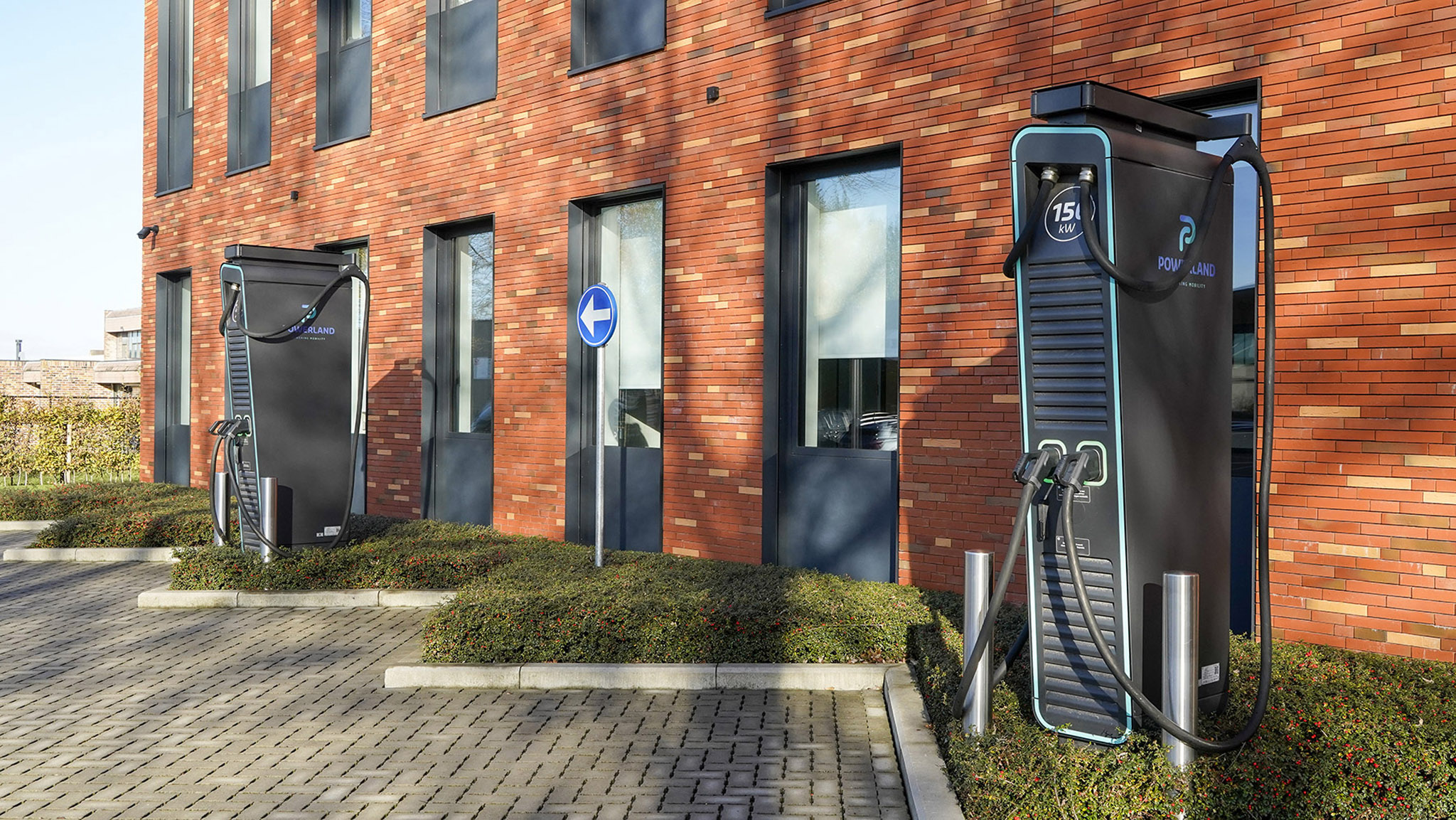
DC fast chargers – 50 to 350 kW

For locations with high traffic and short stop times.
Suitable for situations where multiple vehicles need to top up quickly to continue their route.

Applications:

  • Company fleets
  • Logistics operations
  • Retail car parks with high turnover
  • Showrooms and workshops

More information about DC fast chargers

High-traffic locations and heavy vehicles

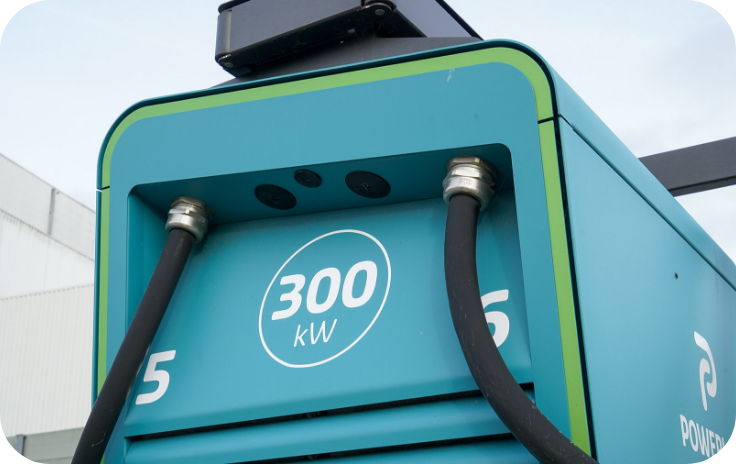
High Power DC / Superchargers – 350 to 1,000 kW

For locations with very high traffic volumes or heavy vehicles requiring high power output.

Applications:

  • Logistics hubs
  • Transport companies
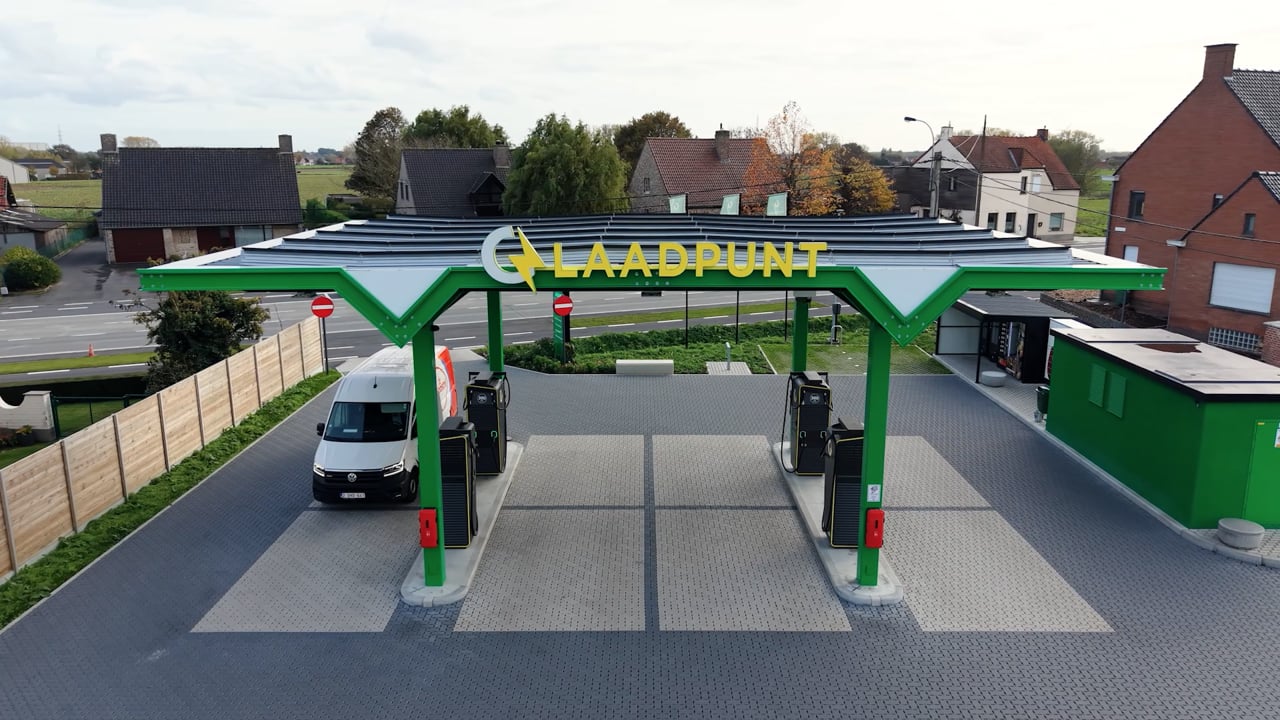
  • Publicly accessible charging locations
  • Trucks, buses and heavy-duty vehicles

Depending on how long vehicles are stationary and how many vehicles charge simultaneously, Powerland selects AC charging, DC fast charging or a combination of both.

Integration with solar panels and battery storage

PV & charging

PV & charging

  • Charge EVs with your own production
  • Lower grid consumption
  • Greater savings
Battery & charging

Battery & charging

  • Peak shaving

  • Stable charging with limited grid capacity
  • No costly grid reinforcement required
EMS & charging

EMS & charging

  • Automatic priority management
  • Reporting

  • Cost allocation per user

How does smart energy management work with charging stations?

An Energy Management System (EMS) automatically distributes the available power across all charging points (load balancing).

Benefits

  • Automatic load balancing
  • Set priorities for fleet charging       
  • Avoid grid reinforcement
  • Prevent power peaks
  • Smart charging based on dynamic tariffs
  • Real-time dashboard and reporting
  • Intelligent queue management
More about EMS
How does smart energy management work

The system always selects the most cost-effective charging strategy and prevents peak loads.

What does charging infrastructure cost for businesses?

Charging infrastructure creates direct ROI through tax deductions, potential employee reimbursements, revenue from public charging and a higher service level for customers and staff.

What does charging infrastructure cost for businesses?

Installation factors that affect the price:

  • Distance to distribution board
  • Cabling and excavation works
  • Additional power study
  • Need for load balancing
  • EMS integration
  • Connection with PV / battery
Contact us

Fully taken care of — from charge card to invoice

Charge cards

Charge cards

  • RFID cards
  • Cost reimbursement
  • Guest access
Employee home charging

Employee home charging

  • Automatic reimbursement
  • Linked to consumption reports
Back-end management

Back-end management

  • CPO platform & dashboards
  • History
  • Cost per user

Whether you need charge cards for your team or full control over your charging infrastructure — Powerland takes care of it.

Request a charge card
Beschrijving

Powerland works with a wide range of charging solutions — from compact AC wallboxes to DC fast chargers up to 1,000 kW. Discover which hardware suits your situation.

View our range
Quote

What an AC charger delivers over a full working day, a DC fast charger achieves during a coffee break.

Pow-Pow

Questions about
charging infrastructure

A fast charger (DC charger) supplies direct current (DC) directly to the vehicle battery. This makes charging much faster than with AC charging, where the car's internal onboard charger only has a limited charging speed.

How does fast charging work technically?

  • The fast charger converts alternating current (AC) to direct current (DC)
  • DC goes directly to the vehicle battery
  • The car's internal charger is bypassed
  • The car itself determines the maximum allowed charging speed for battery safety

Result:
Where AC charging can take 3-8 hours, a DC fast charger can sufficiently charge a vehicle in 15-45 minutes.

Not the type of business, but the traffic volume, charging profile and grid capacity determine whether a DC fast charger is profitable. Therefore we do NOT distinguish businesses, but charging scenarios.

Charging scenario 1: High throughput & short stop time

Suitable for: public charging, retail, gas stations, highway exits, high-traffic zones
Characteristics:

  • many vehicles per day
  • short stops (15-30 min)
  • high occupancy rate
  • early or late need for battery buffering

Charging scenario 2: Medium throughput & mixed use

Suitable for: offices, showrooms, smaller depots, office zones
Characteristics:

  • mix of employees, visitors, occasional vehicles
  • vehicles sometimes stay on site for longer periods
  • lower grid impact

Charging scenario 3: Internal fleet with predictable charging moments

Suitable for: transport, logistics, bus companies, courier services, garbage trucks, forklifts
Characteristics:

  • vehicles return to fixed base
  • often charge in the evening or at night
  • very predictable charging profile
  • perfect match with battery storage

There are tax benefits, increased investment deduction and regional premiums depending on location.

To all questions  

Contact and help

Our customer service and sales team are ready to assist you.
If you are at a charging point and require immediate assistance, you can reach us at +32 57 69 01 05 to speak to an employee.
For non-urgent questions regarding billing or your account, you can email info@powerland.be

Get in touch